> For the complete documentation index, see [llms.txt](https://docs.dreamos.app/llms.txt). Markdown versions of documentation pages are available by appending `.md` to page URLs; this page is available as [Markdown](https://docs.dreamos.app/calls-and-puts.md).
# Calls and Puts
Options allow you to express a view on whether an asset's price will rise or fall over a specific period.
On Dream, you can trade calls and puts across supported assets, with expirations ranging from the same day to one year out.\
\
Although calls and puts are conventionally described as rights to buy or sell an underlying asset, Dream options are cash-settled. At expiration, eligible positions receive a cash payout based on intrinsic value rather than delivery of the underlying asset.
### Call Options
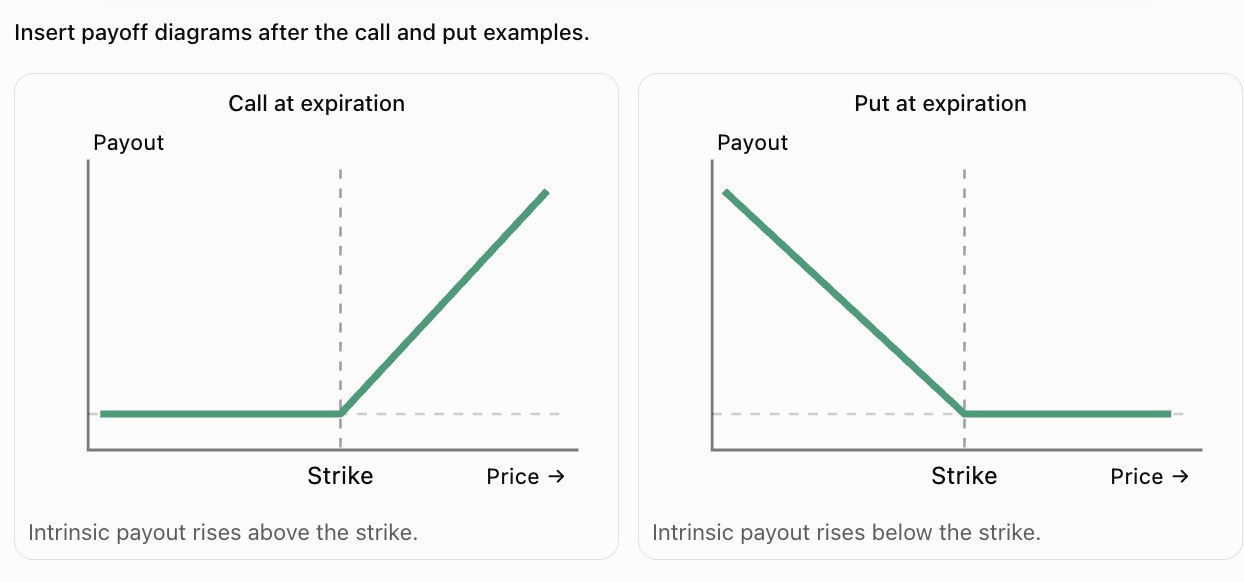
A call option gives the buyer the right, but not the obligation, to purchase an underlying asset at a predetermined strike price.
Calls generally increase in value when the underlying asset's price rises, although their value is also affected by factors such as time remaining until expiration and implied volatility.
#### Example
Bitcoin is trading at $100,000.
You purchase a call option with a strike price of $105,000.
If Bitcoin rises above $105,000 by expiration, the option has intrinsic value and receives a cash-settlement payout.
If Bitcoin expires at or below $105,000, the option expires worthless.
### Put Options
A put option gives the buyer the right, but not the obligation, to sell an underlying asset at a predetermined strike price.
Puts generally increase in value when the underlying asset's price falls, although their value is also affected by time remaining and implied volatility.
#### Example
Bitcoin is trading at $100,000.
You purchase a put option with a strike price of $95,000.
If Bitcoin falls below $95,000 by expiration, the option has intrinsic value and receives a cash-settlement payout.
If Bitcoin expires at or above $95,000, the option expires worthless.\
\
Crossing the strike price does not necessarily mean a trade is profitable. The cash-settlement payout must exceed the total cost of opening the position for the trade to generate a net profit at expiration.
Suppose you buy a BTC $105,000 call representing 1 BTC for a $2,000 premium. Your total cost is $2,000. If BTC settles at $106,000, the option pays $1,000, resulting in a $1,000 net loss. The expiration breakeven price is $107,000.
### Understanding Your Risk
When purchasing a call or put, your maximum loss is limited to the total amount paid to open the position, including applicable fees. Your maximum gain is unlimited.
You are not required to hold an option until expiration. You can request to close it earlier, provided an executable quote is available for your contract and size.
A position can have value before expiration even if the underlying asset has not crossed the strike price.
---
# Agent Instructions
This documentation is published with GitBook. GitBook is the documentation platform designed so that both humans and AI agents can read, navigate, and reason over technical content effectively. Learn more at gitbook.com.
## Querying This Documentation
If you need additional information that is not directly available in this page, you can query the documentation by asking a question.
Perform an HTTP GET request on the following URL with the `ask` and `goal` query parameters:
```
GET https://docs.dreamos.app/calls-and-puts.md?ask=&goal=
```
`ask` is the immediate question: it should be specific, self-contained, and written in natural language.
`goal` is what the user is ultimately trying to achieve, the reason they need the answer. Sharing it helps GitBook give you a better, more relevant answer. A goal is most helpful when it describes the outcome the user wants rather than restating the question. For example, with `ask=how do I create an API token`, a goal like `automate deployments from our CI pipeline` lets GitBook tailor the answer to that use case.
The response will contain a direct answer to the question and relevant excerpts and sources from the documentation.
Use this mechanism when the answer is not explicitly present in the current page, you need clarification or additional context, or you want to retrieve related documentation sections.